

Air Conditioning Services in Weston, MA
- 24/7 Availability
- Family Owned & Operated
- Known for Honesty & Integrity


AC Repair in Weston, MA From a Company That Earns Your Trust
Weston is one of the most distinctive residential communities in eastern Massachusetts, a town deliberately shaped around the preservation of open space, estate-scale properties, and a residential character that prioritizes quality over density. The Charles River borders the town's southern edge, the Case Estates and the Weston Forest and Trail Association lands protect large portions of the interior, and the homes that occupy Weston's residential streets tend to be substantial, well-maintained, and equipped with HVAC systems that reflect the investment put into the properties themselves. Cooling those homes correctly, across significant square footage, through New England's demanding summers, with the river corridor humidity adding to the moisture load on the southern sections of town, is the kind of work that requires both technical capability and honest communication.
Test of Time Plumbing, Heating, Air & Electrical brings both to Weston. We are a family-owned company built on integrity, and we approach every home with the care it deserves.
Our Services
Why Homeowners in Weston, MA Trust Us
AC Repair Services for Weston's Substantial and Varied Homes
Weston's homes span a wider range of architectural styles and construction eras than the town's uniform affluence might suggest. Historic colonials and antique farmhouses in the older sections sit alongside mid-century modern properties, postwar estates, and more recent construction on the town's remaining developable land. What most of them share is size: Weston homes tend to be large, and large homes require cooling systems that are correctly sized, properly maintained, and diagnosed with precision when something goes wrong across one of many zones or in one wing of a complex floor plan.
The repairs we handle most in Weston include:
- Multi-zone system diagnostics for the large homes that make up the majority of Weston's residential stock, including zone board failures, damper motor issues, and thermostat communication breaks that produce uneven comfort across substantial square footage.
- Refrigerant system service for estate-scale properties with longer line runs where the number of connection points increases the likelihood of developing slow leaks over time.
- Drain system maintenance for homes in the southern sections of Weston near the Charles River corridor, where sustained summer humidity drives above-average condensate production through the full cooling season.
- High-efficiency and variable-speed system diagnostics for recently updated Weston properties where modern equipment with sophisticated controls requires specific training and tools to assess correctly.
- Condenser coil cleaning and airflow restoration for outdoor units on Weston's wooded estate lots where organic debris from surrounding conservation land accumulates heavily between service visits.
We diagnose every Weston home on its own terms, explain what we find completely, and start no work without your clear understanding and approval.


What to Watch for in a Weston Home's Cooling System
In a large Weston home with multiple zones, a cooling problem can develop in one area without making the whole house uncomfortable right away. That characteristic, which makes large-home living pleasant when everything is working, can also allow problems to persist longer than they would in a smaller home where a capacity issue is immediately obvious across the entire living space. These are the signals worth looking for proactively rather than waiting for the problem to become undeniable.
- A zone that is running correctly on mild days but failing to keep pace during the hottest afternoons, which reflects a zone-level capacity issue that only surfaces under peak demand rather than a control system failure.
- An outdoor condenser on a wooded Weston lot that has not been inspected in a season or more and is visibly surrounded by leaf debris, cottonwood, or fallen plant material that may have entered the cabinet and restricted the fan.
- A high-efficiency or variable-speed system that has begun operating in a fixed-speed mode rather than modulating output, which can indicate a control board issue or a refrigerant condition that has forced the system into a degraded operating state.
- Increasing condensate drain activity or overflow near the indoor air handler in the southern sections of Weston, where the Charles River humidity keeps dehumidification demand elevated through the full summer.
- An energy bill that has increased significantly compared to the same period last year without a corresponding change in how the home is being used, which reflects efficiency loss across one or more components of a system that may be managing comfort adequately but at substantially higher operating cost.
Large homes and complex systems reward attentive homeowners. These signals are easier to address early than after they have developed through a full season unnoticed.

Estate Properties, Conservation Land, and the Specific Demands of Weston's Environment
Weston's deliberate preservation of open space and conservation land creates an outdoor environment for its residential properties that differs meaningfully from more developed suburban communities of comparable size. The Case Estates, the Weston Aqueduct trail corridor, and the expansive wooded lots that characterize the town produce a sustained pollen, spore, and organic debris load that moves through the local air from April through October. Outdoor condenser units on Weston's estate properties often sit in positions chosen for visual discretion rather than optimal airflow, surrounded by mature plantings and sometimes shaded by large trees that limit the unit's ability to draw fresh air across its coil during operation.
The combination of location-driven airflow restriction and accumulated organic debris loading creates a specific failure pattern in Weston that is less about equipment age and more about maintenance interval and site conditions. A condenser that has been in service for eight years on a Weston estate lot in a shaded, debris-exposed position may be performing more poorly than a 15-year-old unit on an open suburban lot that receives regular service. That performance gap shows up first as higher energy consumption, then as reduced cooling capacity during peak demand, and finally as compressor stress that accelerates the equipment toward premature failure. Understanding the site as part of the system is what separates a thorough diagnosis from one that simply points at the equipment age and recommends replacement when the real issue is addressable through targeted maintenance and coil service.
A Multi-Zone System in the Case Estates Neighborhood
We were called in late July by Elizabeth, who lived in a large colonial in the neighborhood near the Case Estates in Weston. Her home had a five-zone cooling system, and the main living area zone on the first floor had stopped responding to its thermostat while all four other zones continued operating normally. She had checked the thermostat and tried replacing the batteries, but the zone remained unresponsive.
When we inspected the zone control system, we found the zone board relay serving the main living area had failed, which was preventing the damper motor for that zone from receiving an open signal regardless of what the thermostat called for. The damper had consequently been in the closed position for several days, cutting off all conditioned air to the main living area while the rest of the house ran normally. After replacing the failed relay on the zone board and verifying that the damper opened and closed correctly in response to thermostat calls, the main floor zone came back to full operation within the hour. Elizabeth had spent two days troubleshooting the thermostat when the actual fault was a single relay on the zone control board. Accurate diagnosis before parts replacement is exactly what prevented an unnecessary thermostat swap from preceding the actual repair.
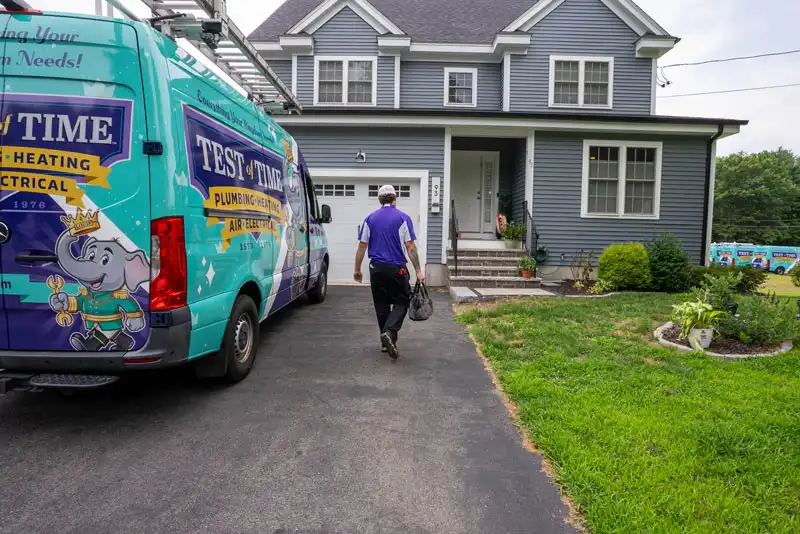
Weston Homeowners Choose A&L Because We Treat Every Home With the Care It Deserves
Weston homeowners invest substantially in their properties and they expect the contractors they hire to bring that same level of seriousness to the work. Test of Time Plumbing, Heating, Air & Electrical was built to meet exactly that expectation. We diagnose thoroughly, communicate honestly, and do work that reflects genuine care for the home and the people who live in it. The Ehrlich family runs this company and stands behind every job we take.
- Emergency availability at any hour, because a zone failure in a large Weston home during a heat wave is a real comfort disruption that should not wait until a scheduled opening.
- Fully licensed and insured technicians experienced with multi-zone systems, high-efficiency equipment, historic home retrofits, and estate-scale HVAC configurations that require careful diagnostic work rather than standard template approaches.
- Honest, complete communication before any work begins, with a clear explanation of what we found, what we recommend, and what each option costs.
- Flexible financing so that a significant repair or planned system replacement fits within your budget on your timeline.
- Maintenance membership plans that account for the wooded lot conditions, conservation land debris loading, and Charles River corridor humidity that make Weston’s outdoor equipment environment more demanding than a standard suburban maintenance schedule assumes.
We are glad to serve Weston. Call us and find out what it looks like when a company genuinely cares about doing the work right.

Frequently Asked Questions
Why does one zone in my Weston home stop working while the others are fine?
A single non-functioning zone in an otherwise operating system almost always points to a zone-specific failure rather than a central equipment issue. Failed zone board relays, damper motors that have seized, and thermostat communication breaks are the most common causes. Each requires a different repair, which is why accurate diagnosis before any part is replaced matters significantly in a multi-zone system.
How does conservation land and a wooded lot affect my outdoor AC unit in Weston?
Wooded lots on conservation-adjacent Weston properties expose outdoor condensers to sustained pollen, spore, and organic debris loading from April through October. Units positioned for visual discretion are often in locations with limited natural airflow as well. Together, these conditions accelerate coil fouling and airflow restriction in ways that reduce performance and increase compressor stress independently of equipment age.
My high-efficiency AC system seems to be running at full speed all the time now instead of modulating. Is that a problem?
Yes. A variable-speed system that has stopped modulating and is running in fixed high-speed mode has typically entered a degraded operating state triggered by a control board issue, a refrigerant condition outside its designed range, or a sensor fault. It is not an emergency, but it is a diagnostic call worth making promptly because running in that state uses more energy and places higher mechanical stress on the components than normal variable-speed operation.
Does the Charles River corridor affect homes in the southern sections of Weston?
Yes. Homes in the southern sections of Weston near the Charles River experience the same sustained summer humidity that river-adjacent properties throughout the corridor deal with: elevated baseline outdoor moisture that keeps AC systems in sustained dehumidification operation and drives above-average condensate production through the full cooling season. Annual drain line service and evaporator coil cleaning are especially important for these properties.
Can you diagnose problems in older retrofitted systems as well as modern high-efficiency equipment?
Yes. We work across the full range of HVAC equipment found in Weston homes, from historic colonial retrofits with non-standard duct configurations to modern variable-speed multi-zone systems with sophisticated electronic controls. We bring the appropriate diagnostic tools for the equipment in front of us and assess the full system rather than applying a one-size approach to a home’s specific configuration.